7 Day Arenal & Manuel Antonio
Highlights of Costa Rica from Arenal to Manuel Antonio
Features
- Arenal Volcano hike
- Visit to a natural hot spring resort with a buffet-style dinner
- Choose one: Class II-III rapids on the Balsa River, Class III-IV on the Toro River, or Safari float down the Peñas Blancas River
- Manuel Antonio National Park hike tour
Highlights
- 6-night accommodations in standard hotels: 3 nights in Arenal & 3 nights in Manuel Antonio (efficiency room)
- Hotel taxes
- Private shuttle transportation from/to Juan Santamaria airport
- Shared-ride shuttle from Arenal to Manuel Antonio
Local Weather
Local Weather
Month | Average Highs | Average Lows | Average Rainfall | Humidity | |||
|---|---|---|---|---|---|---|---|
| F | C | F | C | in. | mm | % |
Jan. | 83 | 28 | 68 | 20 | 7.48 | 192 | n/a |
Feb. | 84 | 29 | 67 | 20 | 5.14 | 132 | n/a |
Mar. | 86 | 30 | 69 | 20 | 3.58 | 92 | n/a |
Apr. | 87 | 31 | 69 | 21 | 3.7 | 95 | n/a |
May | 88 | 31 | 70 | 21 | 10.23 | 262 | n/a |
Jun. | 86 | 30 | 71 | 22 | 16.15 | 414 | n/a |
Jul. | 85 | 30 | 71 | 22 | 19.87 | 509 | n/a |
Aug. | 85 | 30 | 72 | 22 | 17.05 | 437 | n/a |
Sep. | 86 | 30 | 70 | 21 | 16.07 | 412 | n/a |
Oct. | 85 | 30 | 70 | 21 | 16.98 | 435 | n/a |
Nov. | 83 | 29 | 71 | 22 | 12 | 308 | n/a |
Dec. | 82 | 28 | 70 | 21 | 10.1 | 259 | n/a |
Source: National Weather Services of Costa Rica
Month | Average Highs | Average Lows | Average Rainfall | Humidity | |||
|---|---|---|---|---|---|---|---|
| F | C | F | C | in. | mm | % |
Jan. | 87 | 31 | 69 | 21 | 2.83 | 72 | 83 |
Feb. | 87 | 31 | 69 | 21 | 1.42 | 36 | 81 |
Mar. | 89 | 32 | 71 | 22 | 2.36 | 60 | 80 |
Apr. | 89 | 32 | 71 | 22 | 6.57 | 167 | 84 |
May | 89 | 32 | 71 | 22 | 15.43 | 392 | 87 |
Jun. | 87 | 31 | 71 | 22 | 17.05 | 433 | 88 |
Jul. | 87 | 31 | 69 | 21 | 18.15 | 461 | 88 |
Aug. | 86 | 30 | 69 | 21 | 18.82 | 478 | 89 |
Sep. | 86 | 30 | 71 | 22 | 20.79 | 528 | 90 |
Oct. | 86 | 30 | 71 | 22 | 25.35 | 644 | 89 |
Nov. | 86 | 30 | 71 | 22 | 15.28 | 388 | 89 |
Dec. | 86 | 30 | 69 | 21 | 6.65 | 169 | 86 |
Source: National Weather Services of Costa Rica
Attractions
Attractions
Manuel Antonio National Park
The Pacific tides have battered the park's coasts into an extraordinary display of tropical islands, eroded cliffs, errant coves and white-sandy beaches, but to get to them you'll have to cross through the jungle. The park's four trails weave through 1,700 acres of primary and secondary rainforests, past marshy woodlands and mangrove swamps to fall away before Pacific coast vistas.
Walking along the flat, wide main trail into the park, you'll probably encounter two and three-toed sloths lounging in cecropia trees, iguanas recharging in the sunlight, a whole rainbow of tropical birds like the fiery-billed toucan and the occasional palm-pit viper curled in the tree branches (but don't worry they sleep during the day). Visitors can hire a naturalist guide near the park's entrance for around $20 per person, a great way to encounter more of the park's fauna and immerse yourself in the park's biology and history.
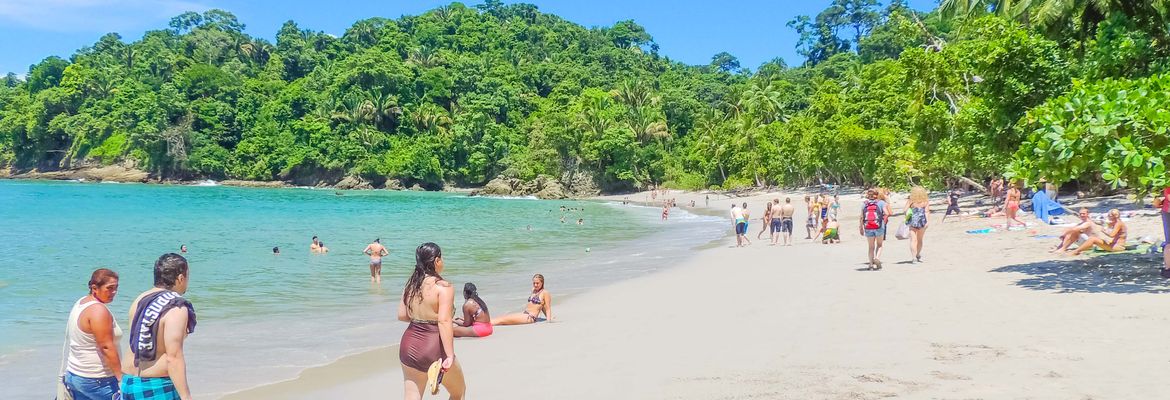
Reach the end of the half-mile main trail and you'll arrive at an idyllic cove sheltering the white sands of Manuel Antonio Beach. Shady coastal almond trees reach out toward the surf while visitors swim in the crystal blue waters and hike the forest trails snaking along the coast to panoramic pacific views along Cathedral point.
Trails
Five short trails meander through the park passing scenic overlooks and pristine beaches. The most popular trail is the small loop that circles around Cathedral point and ends with a wonderful view of the Pacific. All the trails have good signs and are well-maintained.
The Main Trail is a half-mile flat, sandy path that links several beaches. It is an easy trail and the most popular with visitors. Most of the guided hikes slowly make their way along this trail, which passes by mangrove swamps on its way to the beaches.
The Cathedral Point Trail branches off to the right of the main trail and loops around Cathedral Point (an outcropping of land that used to be an island but is now joined to the mainland). The trail is steep in some sections and can be muddy and slippery in the wet season (May-Nov.), but there are plenty of opportunities to stop and take in the views.
The Trampa Trail is a short path that connects the beginning and end of Cathedral Point Trail, completing the loop.
The Playa Gemelas / Punto Escondido Trail leads a mile through the forest to two other beaches of the same names. However, the trail to Playa Escondido is currently closed.
The Mirador Trail is a more challenging climb close to a mile long to a beautiful lookout point.
Beaches
The park has three beaches, each shaded by enormous coconut palms, mangrove and almond trees.
Playa Espadilla Sur is the first and longest beach in Manuel Antonio National Park. It is the widest beach off to the right of the main trail. It is often less crowded than the other beaches and is perfect for strolling at low tide, sunbathing or relaxing under the shade of the park's trees.
Manuel Antonio Beach is a popular beach among tourists and locals. Many families and school children visit this stretch of beach as it offers restrooms, picnic tables, drinking water and showers. The coastal almond trees provide plenty of shade for reclining on the white sands while the gentle currents make this sheltered shore a favored spot for playing in the waves.
Playa Gemelas hike the short Playa Gemelas trail from the gravel road. This beach is typically not crowded. The strong currents and hidden rocks beneath the surface make swimming difficult, if not dangerous. There is a more secluded section of this beach accessible at low tide by walking around a small rock outcropping.
Weather:
Annual Rainfall: 151 inches.
The driest months are January and February while the wettest are August and September. The average temperature is 81- 86 degrees.
Activities
Activities: Bird and wildlife watching, hiking, lounging on the beach and swimming in the ocean are the park’s main activities.
Facilities
The main office for purchasing tickets is outside the park, about 100 hundred yards before the entrance. Along the shores you'll find picnic tables, restrooms, showers and water fountains.
Flora and Fauna:
Manuel Antonio National Park is home to myriad wildlife, including the endangered titi monkey. Only a few troops of these primates are left in Costa Rica. White-faced monkeys, sloths, coatimundis and howler monkeys live throughout the park. Central American whiptail snakes, brown basilisk lizards and anoles hide in the fallen debris while more than 200 bird species conceal themselves in the jungle and among the 12 rocky islands that harbor pelagic birds like the brown booby, frigate bird and pelican.
The park's flora is a combination of tropical, lowland rainforest and coastal vegetation that includes cecropias, almonds and mangrove trees. Watch out for the manzanillo tree near the park entrance; its fruit, leaves and bark are toxic and its sap is a skin irritant (there're warnings near the park entrance).
Recommendations
If you're hiking solely on the sandy Main Trail, flip flops or other light foot wear is adequate. If you're hiking on the other trails, more sturdy footwear like boots or walking shoes help as the paths are sometimes steep and slippery.
Keep in mind that curious animals like monkeys and raccoons will sift through your backpack in hopes of a treat; please do not feed the wildlife as it leads to aggressive behavior and an unnatural dependence on humans.
The best time to bask in the glory of the beach is early. The park opens at 7 a.m. and most visitors go with a local guide between 8:30 a.m. and 9:00 a.m.
A bandana, towel and bathing suit are highly recommended: the water is irresistible. It is hot and humid in the area, so bring plenty of drinking water.
Arenal Volcano National Park
Beyond the brave cane, small twisted trees, more fitting of a desert, grow out of the volcanic soil. Below them the tiny sprouts of touch-me-not plants, droop inward with the slightest brush of a hand or foot.
Rainforest covers more than a third of the 30,000 acre national park. While much of the original rainforest destroyed in Arenal volcano's 1968 eruption, parts survived –even when choked in volcanic ash. At certain places in the park, you can see where the trail separates the rainforest from the brave cane.
Deeper into the park, you'll encounter the remnants of the 1968 eruption's Lava flow; the broken pieces of lichen smeared volcanic badlands that reach up from the rainforest. Standing on top of the lava flow, you can see impressive views of Lake Arenal and the volcano.
Although it's too dangerous to actually walk up Arenal volcano (poisonous gas is always a deterrent), you can still enjoy more than five miles of trails through the parks many habitats including rainforest, grasslands and volcanic badlands.
First-time visitors to Arenal Volcano National Park may notice that one half of the volcano appears charred, black and barren while the other is layered in thick, primary rainforest. During the 1968 eruption, lava and molten rock demolished the western half of the volcano leaving behind ash-covered ground, igneous rock and giant craters from volcanic debris.
Weather:
Average Temperature: 75 to 90 degrees
Annual Rainfall: Up to 195 inches
Weather, as in much of Costa Rica, is unpredictable with clouds rolling in at a moment's notice, obscuring Arenal's near-perfect cone. Increase your odds with a visit during the dry season.
Activities:
Hikes and nature walks are the most popular activities in the park where experts estimate that approximately half of Costa Rica’s land-dwelling vertebrate species live.
Note that, for the safety of park guests, hiking is only permitted on marked trails. Additionally, due to the volcano’s toxic fumes and gases, visitors are not allowed to hike near the volcano's crater.
Camping is not permitted in Arenal Volcano National Park. The Arenal Observatory Lodge is located in the national park and is the only place visitors can legally sleep within the park's boundaries.
Flora & Fauna:
Hikers and wildlife watchers often see howler and spider monkeys, white-nosed coatis, sloths, deer, boa constrictors, parrots, parakeets, black vultures, resplendent quetzals, trogons, hummingbirds, and motmots. Plenty of interesting ferns, heliconia, match trees, brave cane and hardwoods dot the landscape as well.
Facilities:
A ranger station and restrooms are located at the entrance to the park. Trail maps are available at the ranger station.
Trails:
The park has four trails that span more than five miles through the park.
Heliconias Trail: This 0.6-mile loop trail is the ideal introduction to the park and volcano, as it passes by the 1968 lava flow site. The trail has access to a longer one-mile trail that leads to an overlook of the volcano and Lake Arenal.
Las Coladas Trail: Mostly flat, this 1.25-mile trail winds around the base of the volcano, offering views of the 1993 lava flows. This trail connects directly with the Toucans Trail.
Toucans Trail: Continues from the Las Coladas Trail another 1.8 miles through dense, tropical rainforest. This is a great place for spotting wildlife, especially howler and spider monkeys in the trees. On the way back to the park entrance (the trail does not loop, so hikers must double-back), enjoy excellent views of the volcano summit.
Lookout Trail: Accessed only from the park headquarters, the Lookout Trail leads down to Lake Arenal. Located at the base of the volcano, the trail offers great views of the 1968 and 1993 lava flows, as well as Cerro Chato and Arenal Basin.
Recommendations:
Light rain gear is advisable. Visitors can hike park trails on their own or join a guided hike available in La Fortuna.
Getting There:
From La Fortuna drive west toward Tabacon Resort and continue 1.2 miles until you see a sign for the national park. Turn left on the hard-packed dirt road, and then follow the signs to the park, which will be on the left.
A taxi costs approximately $50-60 round-trip from La Fortuna to the western part of the volcano. Buses are available twice a day, 8 a.m. and 2 p.m., cost $5.50, and leave from the La Fortuna bus station.
History:
At approximately 3,000 years old, Arenal Volcano is considered a young volcano. Little is known about its early life, but it had been believed dormant from AD 1500 until 1968. In fact, adventure lovers, hikers and naturalists regularly ascended to the volcano’s summit, often camping out in the cool crater.
On July 29, 1968, for the first time in recorded history, Arenal Volcano erupted. Lava and magma exploded from the volcano, turning its once-green slopes to dots of red and gray ash. Eighty people and approximately 45,000 cattle, in addition to countless wild animals, were killed in the eruption.
The 1968 eruption destroyed several towns, including the original Arenal. Today, those towns lie flooded beneath Lake Arenal, which was created in 1979. The largest lake in Costa Rica, the 21,128-acre reservoir provides almost 50% of Costa Rica’s total electricity, as well as water for farming and irrigation. Arenal Volcano National Park, which is adjacent to Arenal Lake, is an important watershed, providing over 70% of the lake’s water.
Interestingly, Arenal Volcano’s return to active status was not through the old crater – on July 29, lava erupted from three new craters, shooting out enough lava rock to begin creating a new cone beside the old crater. Today, Arenal Volcano’s second cone is a few feet taller than the first, and together, they form what is considered the third-most perfect volcanic cone in the world.
Last updated: Jun 4, 2024